There has been a lot of talk about who the next manager is going to be, about how {insert name here} is or isn’t a good manager or strategist, and so on and so forth. Honestly, as long his last name isn’t Bowa, Williams or Baylor, I could careless who the new manager is. If you look at the teams in the playoffs this season, Phil Garner and Terry Francona led their respective teams into the playoffs after previous years of mediocrity. Mike Scioscia, Jim Tracy, and Rod Gardenhire were relatively “new” managers, who at the least are still with the team who first gave them a shot. Joe Torre suffered through years of mediocrity until 1998 when he became one of the greatest mangers of all time. While it is hard to accurately gauge a manager’s worth to his ball club, some studies believe a good manager is worth 3 to 4 games a year. In short, I’m ambivalent to the whole situation, but I think when all is said and done, Joe Maddon, Grady Little and Mike Hargrove will emerge as the finalists.
There have been some rumors stirring in south Florida that have the Marlins considering dealing third baseman Mike Lowell. Lowell would be eligible to exercise an option in his contract on November 1st that will allow him to become a free agent if the Marlins are unable to secure the proper funding for a new stadium. The Marlins are currently $30 million short in funding. Obviously, the Marlins are trying to trade Lowell because they believe he will exercise his option and will be playing elsewhere in 2005, so they want to get whatever they can for him instead of letting him walk for nothing. Lowell, who will be 31 when the season starts, currently has three years left on his current contract that will pay him $8 million per season. Lowell, who is no slouch with the glove, has been one of the leagues more consistent third basemen over the past three years, posting terrific first half numbers, only to struggle in the second half. The M’s should at least be interested, but they should be very interested in Beltre as well. The top of the Marlins wish list? A left fielder. The Mariners have two.


Friday, October 15, 2004
Given recent managerial speculation (on which an update may be found here, courtesy of John Hickey), I decided to do a little historical reading. I came across a section that seemed particularly relevant to the current situation - Baseball Prospectus 2003's Seattle Mariners team essay. The organization was in an almost identical position prior to hiring Bob Melvin as they are now, so check out what they had to say:
Now, two years later, we're doing the same thing, with a few of the same names even being included. Look at the names cited in the Hickey article:
Now insert that list of names into the Prospectus piece. Maddon takes Melvin's place as the interesting name with no experience. Baylor, Williams, Little, and Collins are the managerial disappointments with name value. Howe is just...Howe is Howe, a run-of-the-mill manager who doesn't have a net positive or negative influence, and who isn't a particularly strong candidate at this point in time anyway.
Baylor, Williams, Little, and Collins are all bad managers (to varying degrees) for their own reasons. Baylor is a poor in-game strategist who overuses some pitchers - while completely ignoring others - and badmouthing certain problem players to the press. Jimy Williams is an irrational octogenarian who flys by the seat of his pants, making decisions on a whim, shuffling his lineups around with no rhyme or reason, and struggling to make a choice of who to start at certain positions despite the presence of a player who may be much more qualified than his competitor (Bill Simmons has suggested that Williams' decisions were dictated to him by a Mr. Weebles, a microscopic man who lives in his mouth). Grady Little is a nice guy who avoids conflict by letting his players make the difficult decisions - DMZ stated that "...as Sox fans will be happy to tell you, Little made many mini-Martinez Mistakes all season long." He was handed excellent teams and guided them to two excellent records, for which he deserves only a little credit. Finally, Collins is a guy who had a knack for finishing second in the division (five years in a row) with talented rosters before he was run out of town in 1999 after his players turned against him.
Bad choices, all of them.
Which brings us to Maddon, who - by process of elimination - looks like the best remaining candidate for the job. He doesn't have any managerial experience, but he's served under Mike Scioscia for a little while, a pretty good manager himself. He's said a lot of the right things, and is considered to be a sharp young mind with a bright future (like assistant GM's Ned Coletti and Chris Antonetti), but before we advance any further, I'd like to remind you of something that Bob Melvin had to say upon his hiring:
Seems like a smart thing to say, right? Well, that same guy fell in love with worthless utility men, irrational sacrifice bunting, abusing young starters, and playing the Matchup Game with the bullpen. Which is to say, what Melvin told the media that winter said nothing of his managerial style, strategy, or tendencies.
And really, who can really say that they're surprised? Melvin had never managed before, and rather than wrack his mind trying to think outside the box for nine innings a day, he found it much simpler to play by the book. In short, he became a typcal, boring manager. This was disappointing, to be sure, as many of us entertained daydreams of an enlightened individual changing the face of the organization from the inside, but it happens to the overwhelming majority of coaches in baseball, as can be inferred from the following chart:

It is my opinion that, as a general rule, managers have a negligible impact on the field, that - over the course of a full season - the good and bad decisions will balance out to create no net effect. This isn't enough to satisfy fans who want a guy to squeeze every last drop of production out of the roster (Jim Tracy has been rumored to possess this ability), but it's usually the best you're going to get. The truly brilliant coaching minds have, for the most part, fallen by the wayside, and the best organizations have compensated by handing good rosters to their managers and expecting them to lead the team to a good season, rather than delivering an average roster and hoping for a miracle.
When looking to hire a manager, one should obey a strict set of guidelines:
By following these rules, an organization can sleep easy with the knowledge that it hasn't put Jimy Williams in charge.
If Mike Scioscia has rubbed off on Joe Maddon at all, then we can expect that Maddon will exhibit some of the following qualities:
1) Won't fall in love with playing lefty/lefty and righty/righty matchups with the bullpen (Anaheim hasn't had a decent southpaw reliever in years)
2) Won't be afraid to play a little smallball (Anaheim was second in the AL in sacrifice bunts and productive outs)
3) Will appreciate intense players who play with heart
4) Will be popular with the players
If you recall, the Angels also kept their best defensive center fielder at first base and left Scot Shields in the bullpen, suggesting that Maddon may not be willing to move Ichiro to CF or flip-flop certain starters and relievers as performance dictates.
Sound familiar?
Joe Maddon is an average baseball mind, and - if he's hired - will likely become an average manager, leading the team to a W/L record that reflects the level of ability of the roster. Everybody wants something better, but truth be told, they should be happy that they didn't get something worse.
Whoever managers the Mariners in 2005 is going to be hailed as a superior coach than Melvin, due simply to the fact that we'll be a better team next year than we were this past summer. The truth of the matter is that we'll probably have the same kind of mind running the clubhouse, only this one will go by a different name than the last.
With that, I'm away for the weekend. I'll see you Sunday evening.
The search for a replacement to lie in Piniella's bed revealed a lot about Mariners management. They really weren't interested in putting together a team that could win in the playoffs, they were interested in getting another name, someone who knew how to glad-hand the press. They didn't care about ability, or record, when they made up their list. They interviewed guys as favors, or on whims. Besides cursory interviews with internal candidates like Tacoma manager Dan Rohn, third-base coach and Snelling Crippler Dave Myers, part-time coach Lee Elia, and M's pitching coach Bryan Price, they flew in a who's who of managerial disappointments of the '90s: Don Baylor, Tony Muser, Jim Riggleman, Terry Francona, and Buddy Bell. There were also some interesting candidates: Willie Randolph, Ron Roenicke, and lastly Bob Melvin (the book had a typo, referring to him as Doug, teh GM), who was added to the interview list on a whim. Melvin so impressed the Mariners in his initial interview that he was put on the short list for callbacks, and ended up winning the job over Sam Perlozzo, Buddy Bell, and Jim Riggleman.
...
Managers don't necessarily have to have previous managerial experience, but seriously, given the choice between a guy with a killer resume and a proven record of doing the same job somewhere else, and a guy who's been around the job as it was done poorly, but has never really done the job in question, but hey, at least he's great in the interview, who's the better choice? This is not to suggest that Dan Rohn or Dave Myers would do a better job than Melvin might, but they've been managers before, and they've done a good job at it.
Now, two years later, we're doing the same thing, with a few of the same names even being included. Look at the names cited in the Hickey article:
- Joe Maddon
- Don Baylor
- Jimy Williams
- Grady Little
- Terry Collins
- Art Howe
Now insert that list of names into the Prospectus piece. Maddon takes Melvin's place as the interesting name with no experience. Baylor, Williams, Little, and Collins are the managerial disappointments with name value. Howe is just...Howe is Howe, a run-of-the-mill manager who doesn't have a net positive or negative influence, and who isn't a particularly strong candidate at this point in time anyway.
Baylor, Williams, Little, and Collins are all bad managers (to varying degrees) for their own reasons. Baylor is a poor in-game strategist who overuses some pitchers - while completely ignoring others - and badmouthing certain problem players to the press. Jimy Williams is an irrational octogenarian who flys by the seat of his pants, making decisions on a whim, shuffling his lineups around with no rhyme or reason, and struggling to make a choice of who to start at certain positions despite the presence of a player who may be much more qualified than his competitor (Bill Simmons has suggested that Williams' decisions were dictated to him by a Mr. Weebles, a microscopic man who lives in his mouth). Grady Little is a nice guy who avoids conflict by letting his players make the difficult decisions - DMZ stated that "...as Sox fans will be happy to tell you, Little made many mini-Martinez Mistakes all season long." He was handed excellent teams and guided them to two excellent records, for which he deserves only a little credit. Finally, Collins is a guy who had a knack for finishing second in the division (five years in a row) with talented rosters before he was run out of town in 1999 after his players turned against him.
Bad choices, all of them.
Which brings us to Maddon, who - by process of elimination - looks like the best remaining candidate for the job. He doesn't have any managerial experience, but he's served under Mike Scioscia for a little while, a pretty good manager himself. He's said a lot of the right things, and is considered to be a sharp young mind with a bright future (like assistant GM's Ned Coletti and Chris Antonetti), but before we advance any further, I'd like to remind you of something that Bob Melvin had to say upon his hiring:
I'd rather see a guy hit .260 with a .360 on-base percentage and doesn't run very well, than a guy who hits .300 with a .310 on-base percentage and runs well.
Seems like a smart thing to say, right? Well, that same guy fell in love with worthless utility men, irrational sacrifice bunting, abusing young starters, and playing the Matchup Game with the bullpen. Which is to say, what Melvin told the media that winter said nothing of his managerial style, strategy, or tendencies.
And really, who can really say that they're surprised? Melvin had never managed before, and rather than wrack his mind trying to think outside the box for nine innings a day, he found it much simpler to play by the book. In short, he became a typcal, boring manager. This was disappointing, to be sure, as many of us entertained daydreams of an enlightened individual changing the face of the organization from the inside, but it happens to the overwhelming majority of coaches in baseball, as can be inferred from the following chart:

It is my opinion that, as a general rule, managers have a negligible impact on the field, that - over the course of a full season - the good and bad decisions will balance out to create no net effect. This isn't enough to satisfy fans who want a guy to squeeze every last drop of production out of the roster (Jim Tracy has been rumored to possess this ability), but it's usually the best you're going to get. The truly brilliant coaching minds have, for the most part, fallen by the wayside, and the best organizations have compensated by handing good rosters to their managers and expecting them to lead the team to a good season, rather than delivering an average roster and hoping for a miracle.
When looking to hire a manager, one should obey a strict set of guidelines:
- Create list of intriguing candidates
- Contact the candidates to gauge level of interest
- Interview interested candidates
- Eliminate the ones that suck
- Hire what's left
By following these rules, an organization can sleep easy with the knowledge that it hasn't put Jimy Williams in charge.
If Mike Scioscia has rubbed off on Joe Maddon at all, then we can expect that Maddon will exhibit some of the following qualities:
1) Won't fall in love with playing lefty/lefty and righty/righty matchups with the bullpen (Anaheim hasn't had a decent southpaw reliever in years)
2) Won't be afraid to play a little smallball (Anaheim was second in the AL in sacrifice bunts and productive outs)
3) Will appreciate intense players who play with heart
4) Will be popular with the players
If you recall, the Angels also kept their best defensive center fielder at first base and left Scot Shields in the bullpen, suggesting that Maddon may not be willing to move Ichiro to CF or flip-flop certain starters and relievers as performance dictates.
Sound familiar?
Joe Maddon is an average baseball mind, and - if he's hired - will likely become an average manager, leading the team to a W/L record that reflects the level of ability of the roster. Everybody wants something better, but truth be told, they should be happy that they didn't get something worse.
Whoever managers the Mariners in 2005 is going to be hailed as a superior coach than Melvin, due simply to the fact that we'll be a better team next year than we were this past summer. The truth of the matter is that we'll probably have the same kind of mind running the clubhouse, only this one will go by a different name than the last.
With that, I'm away for the weekend. I'll see you Sunday evening.

Wednesday, October 13, 2004
Tonight's TV schedule for sports channels:
FOX: MLB Baseball, Red Sox @ Yankees
FOX Sports: NBA Preseason Basketball, Celtics @ Pistons
FX: Behind Enemy Lines, Owen Wilson @ Bosnia
ESPN: College Football, West Virginia @ Connecticut
ESPN2: Soccer, Panama @ US, followed by reruns of the World Series of Poker
NESN: Back-to-back rerun episodes of Adventure Hawaii
YES: This Week In Football (which, I believe, is a rerun of Last Week In Football)
Fox Sports en Espanol: Béisbol de las Grandes Ligas, NLCS Partido 1
ESPN Deportes: Fútbol, Eliminatorias al Mundial 2006: Holanda vs. Finlandia
Fox Sports World: Premiership Soccer, Chelsea @ Liverpool
Madison Square Garden Network: Premiership Soccer (repeat)
So, in order for me to watch the NLCS, I either A) must live in St. Louis or Houston, or B) watch the broadcast in Spanish on a channel that I don't get.
You'd think that, after we were given the opportunity to watch each and every division series game, showing the LCS would be a no-brainer. Think again.
Sometimes I wonder why we even bother with the other 28 teams.
I should add that I do agree with Jim Street on one thing in the Mariners Mailbag:
And also, check out the sponsor on Willie Bloomquist's Baseball Reference page.
Bob Melvin did the same job last season as he did in 2003, but the players did not produce the same way, and therefore 2004 was a poor season...Unless a manager has good players, he won't win, and that is plain and simple. Joe Torre didn't have the talent to win until becoming the Yankees manager. Dick Williams once told me that the best manager in the game is only worth four to five wins a year.
And also, check out the sponsor on Willie Bloomquist's Baseball Reference page.
Contradiction in the Mariners Mailbag:
In response to a question about Jolbert Cabrera and Willie Bloomquist:
And Street's answer to the following question about Justin Leone:
So Leone, who embodies the textbook definition of "home run threat", needs to work on his hitting before he becomes a legitimate candidate for an every day job, despite having every bit the on base abilities of Cabrera and Bloomquist. That makes perfect sense, especially when you consider that he'll cost roughly a fifth as much as Cabrera will in 2005.
How do we explain the Bloomquist phenomenon, anyway? Teams hype their young players all the time in an effort to generate both enthusiasm and market value - the Mariners' public opinion of Wee Willie back when he was still a minor leaguer was not out of line with the behavior of other organizations. A kid with that many tools just has to find out how to put them all together, they said, and then he'll turn into an unstoppable Bremertonian freight train. The extraordinary debut (which we may warmly refer to as Jarrod Washburn's Black September) certainly didn't serve to diminish Bloomquist's perceived value.
A smarter organization would have parlayed the hype and performance over a small sample size into a trade for a more able young body, but the Mariners stuck with the local kid. Forgiveable, we said, because he couldn't be any worse than Jeff Cirillo. We suffered through at bats that made us want to stick screwdrivers in our eyes in anticipation of the Little Ball of Hustle getting his shot.
And, eventually, he got it.
And he sucked.
A .250/.317/.321 in 200+ plate appearances was right in line with Bloomquist's minor league numbers, and that was that. It was established that, over a long enough timeline, the kid would invariably mimic some sort of otherworldly hybrid of Jeff Reboulet and Trenidad Hubbard, blending the worthless versatility of the former with the athleticism of the latter. It has yet to be seen whether or not Bloomquist attempts to mask his boyish appearances with a mustache in his later years.
Nevermind how the organization claims that Willie just needs some time to bloom into a useful young player - he's had his chance, and he bombed. Teams routinely hype their prospects before they arrive at the ML level. The difference between the Mariners and other teams is that, when other teams' hyped prospects fail, they get shipped out. When's the last time you saw Gabe Alvarez with the Tigers? George Arias with San Diego? Fernando Lunar with Baltimore? In order for a young player to stick in the Majors, he needs to develop some sort of redeemable quality that makes him worth having around. Despite what the Mariners have told you, having the right attitude and playing with grit don't put runs on the board. That Willie Bloomquist is guaranteed a spot on the 2005 roster goes to show how this team needs to reconsider its priorities.
I'm going to say it now: we will not have a very pleasing offseason of roster construction until Bloomquist is gone. A front office that values what little he has to bring to the table is a front office that avoids the obvious, expensive available talent and goes on to ignore the inherent risks in signing a Carlos Delgado or Troy Glaus (as hinted at in the article). As much as we all criticized Melvin for his irrational infatuation with Bloomquist, Bob's gone but Willie's still here, suggesting that the orders are coming from higher up on the ladder.
In response to a question about Jolbert Cabrera and Willie Bloomquist:
Neither is a home run threat, but if they were, they would be playing every day in one position and not being moved around so much.
And Street's answer to the following question about Justin Leone:
He showed that he can hit the ball a long way, hitting several second-deck home runs at Safeco Field, but he struck out too many times. He will be spending several weeks in Lara, Venezuela this winter honing his hitting skills.
So Leone, who embodies the textbook definition of "home run threat", needs to work on his hitting before he becomes a legitimate candidate for an every day job, despite having every bit the on base abilities of Cabrera and Bloomquist. That makes perfect sense, especially when you consider that he'll cost roughly a fifth as much as Cabrera will in 2005.
How do we explain the Bloomquist phenomenon, anyway? Teams hype their young players all the time in an effort to generate both enthusiasm and market value - the Mariners' public opinion of Wee Willie back when he was still a minor leaguer was not out of line with the behavior of other organizations. A kid with that many tools just has to find out how to put them all together, they said, and then he'll turn into an unstoppable Bremertonian freight train. The extraordinary debut (which we may warmly refer to as Jarrod Washburn's Black September) certainly didn't serve to diminish Bloomquist's perceived value.
A smarter organization would have parlayed the hype and performance over a small sample size into a trade for a more able young body, but the Mariners stuck with the local kid. Forgiveable, we said, because he couldn't be any worse than Jeff Cirillo. We suffered through at bats that made us want to stick screwdrivers in our eyes in anticipation of the Little Ball of Hustle getting his shot.
And, eventually, he got it.
And he sucked.
A .250/.317/.321 in 200+ plate appearances was right in line with Bloomquist's minor league numbers, and that was that. It was established that, over a long enough timeline, the kid would invariably mimic some sort of otherworldly hybrid of Jeff Reboulet and Trenidad Hubbard, blending the worthless versatility of the former with the athleticism of the latter. It has yet to be seen whether or not Bloomquist attempts to mask his boyish appearances with a mustache in his later years.

Nevermind how the organization claims that Willie just needs some time to bloom into a useful young player - he's had his chance, and he bombed. Teams routinely hype their prospects before they arrive at the ML level. The difference between the Mariners and other teams is that, when other teams' hyped prospects fail, they get shipped out. When's the last time you saw Gabe Alvarez with the Tigers? George Arias with San Diego? Fernando Lunar with Baltimore? In order for a young player to stick in the Majors, he needs to develop some sort of redeemable quality that makes him worth having around. Despite what the Mariners have told you, having the right attitude and playing with grit don't put runs on the board. That Willie Bloomquist is guaranteed a spot on the 2005 roster goes to show how this team needs to reconsider its priorities.
I'm going to say it now: we will not have a very pleasing offseason of roster construction until Bloomquist is gone. A front office that values what little he has to bring to the table is a front office that avoids the obvious, expensive available talent and goes on to ignore the inherent risks in signing a Carlos Delgado or Troy Glaus (as hinted at in the article). As much as we all criticized Melvin for his irrational infatuation with Bloomquist, Bob's gone but Willie's still here, suggesting that the orders are coming from higher up on the ladder.
Tuesday, October 12, 2004
I direct your attention to the Hardball Times, where you may find perhaps the greatest piece of journalism in the history of language.
Yankeez Rool, Boston Is Teh Suck
Yankeez Rool, Boston Is Teh Suck
David Cameron profiles my favorite FA pitcher. Give that a look while I try to find the time to write something of my own.
Monday, October 11, 2004
2004 Major League Baseball Awards (as determined by VORP):
Updated...
AL MVP:
1: Vladimir Guerrero
2: Johan Santana
3: Melvin Mora
4: Ichiro Suzuki
5: Miguel Tejada
NL MVP:
1: Barry Bonds
2: Albert Pujols
3: Todd Helton
4: Adrian Beltre
5: Jim Edmonds
AL Cy Young:
1: Johan Santana
2: Curt Schilling
3: Brad Radke
4: Jake Westbrook
5: Kelvim Escobar
NL Cy Young:
1: Randy Johnson
2: Ben Sheets
3: Carl Pavano
4: Carlos Zambrano
5: Roger Clemens
AL ROY:
1: Zach Greinke
2: Justin Duchscherer
3: Bobby Madritsch
4: Bobby Crosby
5: David Newhan
NL ROY:
1: Khalil Greene
2: Akinori Otsuka
3: Jason Bay
4: Ryan Madson
5: Chad Cordero
Top AL Relief Pitcher:
1: Tom Gordon
2: Mariano Rivera
3: Francisco Rodriguez
4: BJ Ryan
5: Joe Nathan
Top NL Relief Pitcher:
1: Brad Lidge
2: Armando Benitez
3: Akinori Otsuka
4: Scott Linebrink
5: Eric Gagne
Sunday, October 10, 2004
I've been working on a pitcher abuse project off and on for about a week, now, plugging in some numbers and charting the data when I've had some free time. The original intent was to measure the extent to which our rotation was being misused, and with Melvin getting the ol' heave-ho, the timing couldn't be better.
Two things to know before I post the chart:
The overall average weighted age was 28.7, with an avgPAP of 1049.
Montreal's numbers are skewed because Frank Robinson rode Livan Hernandez into the ground, allowing him to collect 356450 PAP's over 35 starts. However, I don't consider that to be an excuse, because last year - when Hernandez was similarly abused - Javy Vazquez amassed 363614 PAP's under Robinson's watch. The Expos established a track record for riding its horses in the rotation, and for that they're slotted in at #1 on the chart.
What you notice is that the Mariners are fourth in PAP's per start - distressing, to say the least - but that they also have one of the oldest rotations in baseball (30.8 wAge), making the first fact a little more palatable. But upon closer inspection, you realize that the age is thrown off by Jamie Moyer and, to a lesser extent, Ryan Franklin, who collected 65 starts between them without getting abused any more than a normal pitcher. It was the younger pitchers who bore the brunt of the workload. Observe:
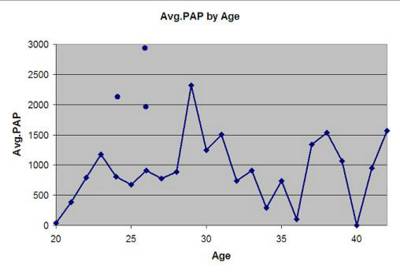
The chart shows the average number of PAP's per start sorted by age. The three floating spots represent Cha Baek, Gil Meche, and Joel Pineiro, each of whom was abused significantly more than their peers. Bobby Madritsch is completely off the chart, as the 28 year old had an average of 8134 PAP's per start - third-highest in the Majors, and approximately nine times as high as his peer group.
Let's take a look at another visual:

The chart here is similar to the one above, only it's sorted by age *groups*, rather than one-by-one. The floating spot represents the Mariners, whose starting pitchers averaged 1915 PAP's per start while falling into the 29-32 year old age group. That 1915 figure is 25% higher than the league average for starters in their late 20's and early 30's.
What's more, the 2003 numbers are very similar. Last year's staff, with a weighted age of 29.7, racked up an average of 2053 PAP's per start. Again, it was the younger pitchers who took most of the workload, as Pineiro and Garcia led the five-man staff in accumulated abuse (while Meche, by comparison, escaped harm).
I didn't begin this project and calculate all the data points with a conclusion in mind. I felt like Bob Melvin was taxing our younger arms more than he should've been, and it turns out that my supposition was correct. The organization has had problems keeping pitchers healthy for some time now, putting together arguably the worst medical track record in all of baseball. Several young arms have been damaged, some permamently, and with more on the way it seems like Melvin just isn't (and wasn't) the right guy for the job. Major League managers need to have numerous abilities, but taking proper care of the starting rotation is pretty high on the list, and Melvin didn't do that (nevermind the five-starter distinction in 2003). While the future of this franchise depends mainly on Bill Bavasi's spending habits, young arms like Travis Blackley, Felix Hernandez, Gil Meche, Clint Nageotte, and a few others are going to be throwing a lot of innings as they try to establish themselves as quality ML starters, and leaving them in the hands of Bob Melvin only serves to make the situation more risky than it already is.
Two things to know before I post the chart:
- wAge is short for Weighted Age - the average age of the starting pitcher for each team over the full season. Let's have an example: if a 20 year old made 10 starts and a 27 year old made 15 starts, then the weighted age would be ((20*10)+(27*15))/25 = 24.2
- avgPAP stands for the average amount of Pitcher Abuse Points accumulated per game by the starting pitcher. Data is recovered from Baseball Prospectus' complete PAP list.
| Team | wAge | AvgPAP |
| Montreal | 27.2 | 2739 |
| SF | 29.1 | 2595 |
| ChiCubs | 28.6 | 1939 |
| Seattle | 30.8 | 1915 |
| Oakland | 26.7 | 1581 |
| NYM | 33.0 | 1552 |
| Milwaukee | 26.9 | 1259 |
| ChiSox | 26.1 | 1194 |
| Houston | 30.6 | 1164 |
| St. Louis | 30.1 | 1081 |
| Atlanta | 30.1 | 971 |
| Toronto | 28.8 | 936 |
| Boston | 32.6 | 930 |
| Arizona | 30.3 | 914 |
| Detroit | 26.2 | 797 |
| NYY | 32.9 | 760 |
| Florida | 25.4 | 736 |
| Pittsburgh | 25.5 | 722 |
| LA | 30.3 | 720 |
| Anaheim | 29.5 | 708 |
| Colorado | 28.2 | 703 |
| Philly | 27.2 | 650 |
| Baltimore | 26.0 | 628 |
| Cleveland | 25.7 | 612 |
| Texas | 30.5 | 600 |
| KC | 26.7 | 592 |
| Tampa Bay | 27.6 | 492 |
| Cincinatti | 27.8 | 466 |
| Minnesota | 28.0 | 453 |
| San Diego | 29.3 | 398 |
The overall average weighted age was 28.7, with an avgPAP of 1049.
Montreal's numbers are skewed because Frank Robinson rode Livan Hernandez into the ground, allowing him to collect 356450 PAP's over 35 starts. However, I don't consider that to be an excuse, because last year - when Hernandez was similarly abused - Javy Vazquez amassed 363614 PAP's under Robinson's watch. The Expos established a track record for riding its horses in the rotation, and for that they're slotted in at #1 on the chart.
What you notice is that the Mariners are fourth in PAP's per start - distressing, to say the least - but that they also have one of the oldest rotations in baseball (30.8 wAge), making the first fact a little more palatable. But upon closer inspection, you realize that the age is thrown off by Jamie Moyer and, to a lesser extent, Ryan Franklin, who collected 65 starts between them without getting abused any more than a normal pitcher. It was the younger pitchers who bore the brunt of the workload. Observe:

The chart shows the average number of PAP's per start sorted by age. The three floating spots represent Cha Baek, Gil Meche, and Joel Pineiro, each of whom was abused significantly more than their peers. Bobby Madritsch is completely off the chart, as the 28 year old had an average of 8134 PAP's per start - third-highest in the Majors, and approximately nine times as high as his peer group.
Let's take a look at another visual:

The chart here is similar to the one above, only it's sorted by age *groups*, rather than one-by-one. The floating spot represents the Mariners, whose starting pitchers averaged 1915 PAP's per start while falling into the 29-32 year old age group. That 1915 figure is 25% higher than the league average for starters in their late 20's and early 30's.
What's more, the 2003 numbers are very similar. Last year's staff, with a weighted age of 29.7, racked up an average of 2053 PAP's per start. Again, it was the younger pitchers who took most of the workload, as Pineiro and Garcia led the five-man staff in accumulated abuse (while Meche, by comparison, escaped harm).
I didn't begin this project and calculate all the data points with a conclusion in mind. I felt like Bob Melvin was taxing our younger arms more than he should've been, and it turns out that my supposition was correct. The organization has had problems keeping pitchers healthy for some time now, putting together arguably the worst medical track record in all of baseball. Several young arms have been damaged, some permamently, and with more on the way it seems like Melvin just isn't (and wasn't) the right guy for the job. Major League managers need to have numerous abilities, but taking proper care of the starting rotation is pretty high on the list, and Melvin didn't do that (nevermind the five-starter distinction in 2003). While the future of this franchise depends mainly on Bill Bavasi's spending habits, young arms like Travis Blackley, Felix Hernandez, Gil Meche, Clint Nageotte, and a few others are going to be throwing a lot of innings as they try to establish themselves as quality ML starters, and leaving them in the hands of Bob Melvin only serves to make the situation more risky than it already is.
It's beginning to feel a lot like last winter.
The list of managers who I don't want in Seattle under any circumstances is a short one, but Baylor is near the top. Joe Maddon? Fine. Larry Dierker? Fine. Art Howe? Fine. Don Baylor? Not fine. Trent's convinced that he's just the token minority candidate, so we'll see where this goes.
DMZ said it best:
Baylor, who guided the Rockies into the postseason in 1995, their third year of existence, is emerging as a hot managerial candidate this winter.
The list of managers who I don't want in Seattle under any circumstances is a short one, but Baylor is near the top. Joe Maddon? Fine. Larry Dierker? Fine. Art Howe? Fine. Don Baylor? Not fine. Trent's convinced that he's just the token minority candidate, so we'll see where this goes.
DMZ said it best:
Don Baylor, former manager, Rockies 1993-1998, Cubs 2001-2002. No. No way. Along with Larry Bowa...if your team’s considering Don Baylor you should hope you can still get your season ticket deposit back.
Thursday, October 07, 2004
Thanks to Bob Finnigan there is some confusion and in some instances panic throughout the blogosphere and in Mariner fans everywhere regarding this off-season. Dave should help to calm some of the skeptics with a terrific post on USSM and over the next few weeks we all should know the direction the M's will be taking in 2005 and beyond. I have yet to jump onboard the "Playoffs in 2005" bandwagon but despite the negativity floating around, I am more optimistic than most. I compiled a rough estimate for how the 2005 payroll currently stands, although you can expect a large player turnover for 2005.
By taking the M's supposed payroll of $95 million and subtracting the estimated payroll, the team is left with roughly $20-21 million to spend on free agents. Keep in mind the $74.11 million figure includes everyone on the 40 man roster and there are definitely going to be players on this list today that will not be on this same list in a month. There are a lot of what ifs that remain unanswered so I recommend sitting down with your favorite brew and just enjoying some playoff baseball. We have months to worry about 2005.
Pos | Player | 2005 Salary | Expected 2005 |
P | Atchinson, Scott | ~ | $.30 |
P | Baek, Cha Seung | ~ | $.05 |
P | Blackley, Travis | ~ | $.05 |
IF | Bloomquist, Willie | ~ | $.40 |
2B | Boone, Bret | $9.0 | ~ |
IF/OF | Cabrera, Jolbert | ~ | $1.5 |
3B | Dobbs, Greg | ~ | $.05 |
P | Franklin, Ryan | $2.40 | ~ |
OF | Garbe, B.J. | ~ | $.05 |
C | Gonzalez, Wiki | $2.25 | ~ |
P | Guardado, Eddie | $7.00* | ~ |
P | Hasegawa, Shigetoshi | $2.98 | ~ |
P | Heaverlo, Jeff | ~ | $.05 |
OF | Ibanez, Raul | $3.75 | ~ |
DH | Jacobsen, Bucky | ~ | $.30 |
P | Johnson, Rett | ~ | $.05 |
3B | Leone, Justin | ~ | $.05 |
P | Looper, Aaron | ~ | $.05 |
SS | Lopez, Jose | $.30 | ~ |
P | Madritsch, Bobby | $.30 | ~ |
P | Mateo, Julio | $.40 | ~ |
P | Meche, Gil | $2.50 | ~ |
P | Moyer, Jamie | $7.50 | ~ |
P | Nageotte, Clint | ~ | $.05 |
C | Olivo, Miguel | ~ | $.40 |
P | Pineiro, Joel | $4.20 | ~ |
P | Putz, J.J. | $.30 | ~ |
OF | Reed, Jeremy | ~ | $.05 |
C | Rivera, Rene | ~ | $.05 |
SS | Santiago, Ramon | ~ | $.05 |
P | Sherrill, George | $.30 | ~ |
OF | Snelling, Chris | ~ | $.30 |
P | Soriano, Rafael | $.35 | ~ |
IF | Spiezio, Scott | $3.10 | ~ |
OF | Strong, Jamal | ~ | $.05 |
OF | Suzuki, Ichiro | $10.75** | ~ |
P | Taylor, Aaron | ~ | $.05 |
P | Thorton, Matt | ~ | $.05 |
P | Villone, Ron | ~ | $2.00*** |
C | Wilson, Dan | ~ | $2.00 |
OF | Winn, Randy | $3.75 | ~ |
IF | Cirillo, Jeff | $4.78 | ~ |
Subtotal | $61.46 | $12.65 | |
Total | $74.11 | ||
* Based on the assumption that the team picks up his option, plus his $1 million bonus
** Based on $250K in bonus money for plate appearances
*** The feeling is that he will be back, I'm praying he isn't
By taking the M's supposed payroll of $95 million and subtracting the estimated payroll, the team is left with roughly $20-21 million to spend on free agents. Keep in mind the $74.11 million figure includes everyone on the 40 man roster and there are definitely going to be players on this list today that will not be on this same list in a month. There are a lot of what ifs that remain unanswered so I recommend sitting down with your favorite brew and just enjoying some playoff baseball. We have months to worry about 2005.
If you're having trouble getting excited about this year's brand of October baseball and all you want to hear about is how the Mariners intend to go about rebuilding the team this winter, go read David Cameron's piece.
Go ahead, tell me you aren't looking forward to the winter.
Last year, the team tried playing that game where you spread your hand on a table and quickly poke a knife between each finger, and it lost some digits.

Undeterred, they decided to pick it up a notch and enter this offseason tied to a rotating disc, with another guy throwing knives at the circle and trying to miss the person. If they succeed, then they're the most entertaining group of guys on the planet, but if they fail...well, there are better analogies than this one, so forget it. I'm excited.
The M’s are going to spend a lot of money this winter. I can’t guarantee they are going to spend it all well, but I can tell you that several of the players we would like to see in Seattle will be forced into deciding to take less money from another organization to turn down the Mariners offer. And, with very few exceptions, the high bidder almost always gets the player in free agency.
Go ahead, tell me you aren't looking forward to the winter.
Last year, the team tried playing that game where you spread your hand on a table and quickly poke a knife between each finger, and it lost some digits.

Undeterred, they decided to pick it up a notch and enter this offseason tied to a rotating disc, with another guy throwing knives at the circle and trying to miss the person. If they succeed, then they're the most entertaining group of guys on the planet, but if they fail...well, there are better analogies than this one, so forget it. I'm excited.
Brief synopsis of Howard Lincoln’s responses to questions asked by Groz this afternoon on KJ:
“We are not going to get silly (this offseason).”
The fans don't want silly, we want smart.
“We don’t have any set rules on contract lengths. We were willing to give Rhodes and Suzuki four year contracts. One thing Pat Gillick and Bill Bavasi are aware of are that long-term contracts are risky.”
No rules, yet in the past five years only two players have signed four year contract offers?
“Our budget for the next fiscal year will include an operating loss in the millions, partly because we will maintain a top 10 payroll.”
Obviously they are anticipating a considerable drop in attendance, as they should be.
“This was the toughest year…way we played was unexpected…we disappointed the fans…we, as an organization, felt good coming out of spring training.”
“This was a very disappointing season…unacceptable…we called up our ML ready prospects becaue we are bound and determined to give Bavasi the ability to discover holes and figure out where the priorities lie.”
“It was swing and miss. We couldn’t anticipate the decline of the veterans. It was hard to believe that after Ichiro and Winn there was nothing.”
What?!? Where the hell have these guys been since last year? These were some of the most disturbing parts of the interview. Groz had asked questions pertaining to a change in the organizational philosophies when it came to evaluating players due to the results of this past season. The majority of the blogoshpere anticipated a significant drop off from numerous players, (nothing as severe as what actually occurred though). This further illustrates that the brain trust of the team really doesn’t understand what went wrong.
The final tidbit is one that DMZ and the other fans of the beer garden should be pleased to hear:
“The bricks will be moved this offseason. I was amazed that no one noticed that the temporary bleachers covered up a section of the bricks, albeit a small one. Every organization makes mistakes and we are extremely sorry for covering up those bricks... It will be rare that those bleachers will be up in the near future.”
Nothing to new came out of the interview that we didn’t already know, but it is just further evidence that they aren’t ready to make the necessary changes required to turn this team around quickly.
Breaking Down Bob Finnigan's "M's try to head off winter of discontent".
How many times have we heard that one? The Mariners currently have ~$64m tied up in 2005 payroll once you factor in incentives for Boone and Moyer, and the money we sent to San Diego in the Cirillo trade. Going with the $92m payroll figure cited by Lincoln later in the article, that would leave us with about $28m to spend this winter - exactly what has been speculated. Rookies who stick around on the roster next year (Madritsch, Lopez, Putz, possibly Reed, etc) won't cost much of anything, so the team should have more payroll flexibility than it has in recent memory.
It's a promising quotation, but then you scroll down:
What we have here are different plans. Mind you, they're not mutually exclusive - signing some of the younger free agent talents (Beltran, Beltre, Drew, etc) would accomplish both tasks. However, it leaves open the likely possibility that the club settles for three-year deals with the next Ibanez and Spiezio, stopgaps with a little name value who are beyond their best years, but not yet at the end of their careers. Lincoln wants the team to be successful again in order to generate fan interest and revenue, and emotions have a tendency to cloud rational thought. If and when you hear that the team is negotiating with Carlos Delgado, then you can be sure that nobody's learned anything.
You mean like you did when you passed off Raul Ibanez as the big bat this team needed in the middle of the order? Like you did when you decided that Scott Spiezio would be an acceptable long-term solution to our Cirillo problem? Like you did when you declared that Ramon Santiago and The Bad Juan Gonzalez were an acceptable return on Carlos Guillen? Like you did when you claimed that Quinton McCracken was a valuable, versatile fourth outfielder? Like you did when you said that there was no way to predict this kind of dismal season?
Any single member of this blogosphere community could've told you that Scott Spiezio was a bad investment, champ. "Sure thing" contracts don't exist, but a little research can make it a simpler process. Besides, ignoring market value and caving in to the players' demands is no way to make sure that you get your money's worth.
So, we need pitching, hitting, defense, and leadership - in other words, we're essentially starting from scratch. Except that we're not, because we already have a bunch of money tied up in 2005 payroll. You can dream about building the strongest, fastest car on the road, but you won't get very far when 70% of your starting material is balsa wood.
So, either we'll burn a year of service time on a player who isn't ready for an everyday ML job, or we'll send him to the minors after loading up the big league team with short-term veterans. When presented with the option of sacrificing a player or sacrificing a team, you will invariably choose the former. Now look, all of a sudden you're not so sure you want the team to contend next year...
This is something the front office needs to figure out before they go after anyone. The 2004 Mariners were two top-tier position players away from contention. Signing a Carlos Delgado, a Derek Lowe, or a Corey Koskie isn't going to have much of an impact on next year's team. The recent strategy of surrounding our best bats and arms with mid-range players isn't going to cut it this time, because we don't *have* those bats and arms anymore. Edgar's gone, Boone's getting slower, Moyer's getting lit up, Pineiro may not pitch at all in 2005...looking at the players we'll have around next year, there is only one guy who you can confidently assume will turn in an above-average performance (Ichiro). The lineup and rotation each need to be rebuilt, because the core that's carried them for the last handful of years is almost entirely gone. It's one of the reasons that I'm cautiously optimistic about this offseason - the conservative front office has never faced a situation so drastic - but it's also one of the reasons that I wake up screaming at night, and realize that I hadn't even fallen asleep.
What?
What?
Coincidentally, we have people who can play anywhere. It's pretty easy to change the sentence to "...while the most common guess has been third base, with Los Angeles free agent Adrian Beltre often mentioned, Seattle has people who can play there, Cabrera for offense and Bloomquist for defense." It works for any position. Left field? Winn, Reed, Ibanez. Shortstop? Lopez, Bloomquist. Center field? Winn and Reed again. Don't buy this. If you want to build a competitive roster and have a marginal player hanging around, you don't find a place to play that marginal player every day. Rather, you admit that you screwed up, get rid of him one way or another (trade, bench, waive), and bring in somebody better. Just because Jeremy Reed stands in the middle of the outfield 120 times a year doesn't mean that you cross Carlos Beltran off your list.
With sufficient upgrades at other positions, I'm sure Leone and Cabrera could handle it.
Two over-30 hitters about to become expensive (although Carlos will still be taking a paycut) in free agency? Bad ideas come in pairs this year.
There are so many things wrong with this, I don't know where to begin (or even if it's worth it). Matt Clement is the only member of that list who even comes close to being a good idea. And how can you put him on the same level as Cory friggin' Lidle? Why are we trying hard to re-sign Ron Villone? Why does...he isn't...I don't...
How many really good years has Ron Villone had?
First of all, Scott Williamson is going to miss all of 2005 following surgery - he'll be signed to the kind of wait-and-see contract that Jon Lieber got from New York. Secondly, what's the point of signing a "veteran closer" when A) the options aren't very good, B) the team isn't going to compete in 2005, particularly if a closer is high on the list of offseason priorities, and C) Guardado's still under contract, and Soriano is considered our "closer of the future"? Where is the possible benefit here?
I do like the idea of dealing for Scot Shields (next sentence in the article), though.
What?
The bad Miguel Olivo was every bit as good offensively as Dan Wilson. Trading him - one of the few remaining young bright spots in the organization - would make me question whether or not following this team is really worth the time and effort.
How are...Hillenbrand...same level of...it doesn't...
This might be my favorite part of the article. So giving Tejada a six-year deal is inconceivable, but trading for him after an extremely productive first season somehow makes sense? If the organization was afraid of getting burned in the later years of the deal...well, nothing's changed. I can't explain how I'm feeling right now - I don't think a sufficient word exists, although if it did, it would be close to "confuriated".
How sensible - dealing for a 37 year old shortstop with a .246 career EqA. But hey, at least he proved our team doctors wrong by playing in 148 games last year. Seriously, is there any good news *anywhere* in this article?
If that's the perfect world, then just kill me now.
About all that is widely known is that the Mariners will have money to work with — while less than previous speculation, it should be about $20 million to $22 million...
How many times have we heard that one? The Mariners currently have ~$64m tied up in 2005 payroll once you factor in incentives for Boone and Moyer, and the money we sent to San Diego in the Cirillo trade. Going with the $92m payroll figure cited by Lincoln later in the article, that would leave us with about $28m to spend this winter - exactly what has been speculated. Rookies who stick around on the roster next year (Madritsch, Lopez, Putz, possibly Reed, etc) won't cost much of anything, so the team should have more payroll flexibility than it has in recent memory.
"Anything we do," said general manager Bill Bavasi, who this week is leading organizational meetings in Peoria, Ariz., "will not just be for next season, but with an eye to 2005, 2006 and 2007."
It's a promising quotation, but then you scroll down:
Mariners CEO Howard Lincoln promised in a letter to season-ticket holders the team would return to contention as soon as possible.
What we have here are different plans. Mind you, they're not mutually exclusive - signing some of the younger free agent talents (Beltran, Beltre, Drew, etc) would accomplish both tasks. However, it leaves open the likely possibility that the club settles for three-year deals with the next Ibanez and Spiezio, stopgaps with a little name value who are beyond their best years, but not yet at the end of their careers. Lincoln wants the team to be successful again in order to generate fan interest and revenue, and emotions have a tendency to cloud rational thought. If and when you hear that the team is negotiating with Carlos Delgado, then you can be sure that nobody's learned anything.
"We won't try to fool our fans."
You mean like you did when you passed off Raul Ibanez as the big bat this team needed in the middle of the order? Like you did when you decided that Scott Spiezio would be an acceptable long-term solution to our Cirillo problem? Like you did when you declared that Ramon Santiago and The Bad Juan Gonzalez were an acceptable return on Carlos Guillen? Like you did when you claimed that Quinton McCracken was a valuable, versatile fourth outfielder? Like you did when you said that there was no way to predict this kind of dismal season?
"This club understandably got caught with some contracts," Bavasi said. "It's hard to have it end perfectly, where the club gets its money's worth and the player may be through. It's tough on either part."
Any single member of this blogosphere community could've told you that Scott Spiezio was a bad investment, champ. "Sure thing" contracts don't exist, but a little research can make it a simpler process. Besides, ignoring market value and caving in to the players' demands is no way to make sure that you get your money's worth.
Now, with former manager Bob Melvin paying the price of the lack of production that led to 99 losses, Bavasi and his staff must come up with a manager and an offense, ostensibly in that order, and more pitching and defense, too.
So, we need pitching, hitting, defense, and leadership - in other words, we're essentially starting from scratch. Except that we're not, because we already have a bunch of money tied up in 2005 payroll. You can dream about building the strongest, fastest car on the road, but you won't get very far when 70% of your starting material is balsa wood.
After he looked almost ready for the majors when rushed up this year, although not necessarily at shortstop, Lopez will play every day next season at age 21...If he is in the minors, honing his play at shortstop or moving to second or third, Seattle has opted to go for contention next season.
So, either we'll burn a year of service time on a player who isn't ready for an everyday ML job, or we'll send him to the minors after loading up the big league team with short-term veterans. When presented with the option of sacrificing a player or sacrificing a team, you will invariably choose the former. Now look, all of a sudden you're not so sure you want the team to contend next year...
"When you see Jolbert Cabrera hitting fifth, and Melvin had him there a lot the last four weeks, your offense is in trouble. In fact, you don't have an offense. Cabrera is a nice role guy but has to hit much lower in a big-league lineup. For Seattle, it will be tough to be real good very soon."
This is something the front office needs to figure out before they go after anyone. The 2004 Mariners were two top-tier position players away from contention. Signing a Carlos Delgado, a Derek Lowe, or a Corey Koskie isn't going to have much of an impact on next year's team. The recent strategy of surrounding our best bats and arms with mid-range players isn't going to cut it this time, because we don't *have* those bats and arms anymore. Edgar's gone, Boone's getting slower, Moyer's getting lit up, Pineiro may not pitch at all in 2005...looking at the players we'll have around next year, there is only one guy who you can confidently assume will turn in an above-average performance (Ichiro). The lineup and rotation each need to be rebuilt, because the core that's carried them for the last handful of years is almost entirely gone. It's one of the reasons that I'm cautiously optimistic about this offseason - the conservative front office has never faced a situation so drastic - but it's also one of the reasons that I wake up screaming at night, and realize that I hadn't even fallen asleep.
Dan Wilson, virtually a must-return free agent unless the Mariners can coax Jason Varitek to come back as a free agent...
What?
Longshot: Lopez, Miguel Olivo, Bucky Jacobsen.
What?
While the most common guess has been first base, with Toronto free agent Carlos Delgado often mentioned, Seattle has people who can play there, Ibanez for offense and Spiezio for defense.
Coincidentally, we have people who can play anywhere. It's pretty easy to change the sentence to "...while the most common guess has been third base, with Los Angeles free agent Adrian Beltre often mentioned, Seattle has people who can play there, Cabrera for offense and Bloomquist for defense." It works for any position. Left field? Winn, Reed, Ibanez. Shortstop? Lopez, Bloomquist. Center field? Winn and Reed again. Don't buy this. If you want to build a competitive roster and have a marginal player hanging around, you don't find a place to play that marginal player every day. Rather, you admit that you screwed up, get rid of him one way or another (trade, bench, waive), and bring in somebody better. Just because Jeremy Reed stands in the middle of the outfield 120 times a year doesn't mean that you cross Carlos Beltran off your list.
But they have no viable everyday option at third base.
With sufficient upgrades at other positions, I'm sure Leone and Cabrera could handle it.
Can Seattle land the likes of Lowell and/or Delgado?
Two over-30 hitters about to become expensive (although Carlos will still be taking a paycut) in free agency? Bad ideas come in pairs this year.
Once beyond Villone, whom the Mariners will try hard to re-sign, candidates for Seattle could be the likes of Derek Lowe, who pitched at times better than his Boston numbers showed, Brad Radke, Eric Milton, Matt Clement and Cory Lidle.
There are so many things wrong with this, I don't know where to begin (or even if it's worth it). Matt Clement is the only member of that list who even comes close to being a good idea. And how can you put him on the same level as Cory friggin' Lidle? Why are we trying hard to re-sign Ron Villone? Why does...he isn't...I don't...
Carl Pavano and Jaret Wright could figure, but good as they were in 2004 for Florida and Atlanta, each have had only one really good year.
How many really good years has Ron Villone had?
Figure first that Seattle might opt to add one reliever at least with experience as a closer, such as Scott Williamson, Bob Wickman or Ugueth Urbina.
First of all, Scott Williamson is going to miss all of 2005 following surgery - he'll be signed to the kind of wait-and-see contract that Jon Lieber got from New York. Secondly, what's the point of signing a "veteran closer" when A) the options aren't very good, B) the team isn't going to compete in 2005, particularly if a closer is high on the list of offseason priorities, and C) Guardado's still under contract, and Soriano is considered our "closer of the future"? Where is the possible benefit here?
I do like the idea of dealing for Scot Shields (next sentence in the article), though.
The Mariners certainly won't deal Madritsch, whose work in the majors put him on the same can't-miss level as super prospect Felix Hernandez
What?
Thus, to trade, Bavasi could try to peddle the likes of Olivo, who had a dropoff in play that stunned Seattle officials after he came over from the White Sox
The bad Miguel Olivo was every bit as good offensively as Dan Wilson. Trading him - one of the few remaining young bright spots in the organization - would make me question whether or not following this team is really worth the time and effort.
It is unknown if Seattle has enough to bring in the likes of Tampa Bay's Aubrey Huff or Arizona's Shea Hillenbrand.
How are...Hillenbrand...same level of...it doesn't...
or make a big play for Miguel Tejada, now that his contract has a more acceptable five years to go.
This might be my favorite part of the article. So giving Tejada a six-year deal is inconceivable, but trading for him after an extremely productive first season somehow makes sense? If the organization was afraid of getting burned in the later years of the deal...well, nothing's changed. I can't explain how I'm feeling right now - I don't think a sufficient word exists, although if it did, it would be close to "confuriated".
Using more Mariners-like sensibility, they might try Omar Vizquel again. The Wiz has wanted back to Seattle for some time and showed he is healthy with a solid 2004 season.
How sensible - dealing for a 37 year old shortstop with a .246 career EqA. But hey, at least he proved our team doctors wrong by playing in 148 games last year. Seriously, is there any good news *anywhere* in this article?
But that's the perfect world of re-building, now for reality time.
If that's the perfect world, then just kill me now.
Wednesday, October 06, 2004
Art Thiel interviewed Howard Lincoln yesterday and once again delivered an excellent article. I encourage everyone to read the transcript of the interview and draw your own conclusions. For the first time since Lincoln has been here, I get the distinct impression that he is finally getting it, but continues to talk out of both sides of his mouth. Only time will tell if he is actually committed to improving the ballclub or just talking the talk without walking the walk.
From the Seattle Times:
If speculation proves correct, his second chance might come quickly. Arizona newspapers are reporting that Melvin, who came to Seattle after being the Diamondbacks' bench coach, is high on that club's list of managerial candidates.
Word is Arizona president Jerry Colangelo called Melvin yesterday, but whether he gets the job or another one, he is expected to make Bryan Price his pitching coach.
Personally, I believe Price has been given a lot more credit than he should be given for turning around the pitchers in Seattle. Since Price took control in 1999, the quality of pitchers that have come through the system has been much improved, (Bobby Ayala and Heathcliff Slocumb to Arthur Rhodes and Jeff Nelson). Part of this can be credited to Price, but a large part of the credit goes to the scouting department and front office for bringing in and drafting better pitchers. You also can't ignore the impact SafeCo has had on the pitchers either. Add to the equation the numerous career threatening injuries to our young pitchers since 2000 and the thought of losing Price doesn't appear to be as negative as some may think. While I'm not advocating for Price's removal, if he does in fact leave, this is one fan that won't be that upset.
Roger Jongewaard is gone.
His recent drafts have been undeniably terrible, but Jongewaard deserves praise for playing an instrumental role in extending the club's focus towards Asia and Australia, from which he was able to snag Shin-soo Choo, Travis Blackley, Chris Snelling, Cha Baek, and a handful of others.
Also, Bob Melvin speaks out:
"I appreciate Bill respecting my privacy," Melvin said yesterday. "But I have no problem telling you that, among other things, what he said was the primary reason (for the manager's dismissal) was that the players who left here did better, and the players we brought in didn't.
You be the judge.
Subscribe to:
Posts (Atom)